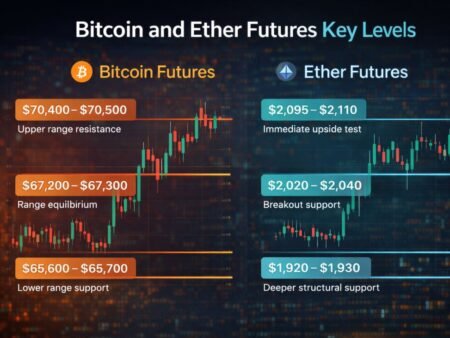
Shifting focus to crypto, Bitcoin’s breakout earlier this week has paused near $69K as short-term pressure builds and traders digest the prior upside push. But underneath the headline move in BTC, the broader digital asset complex was showing a more nuanced recovery very early yesterday, with Ether quietly looking stronger on the margin.
Then as yesterday progressed, we got the boom. Even though some crypto short sellers were in ego and could not ditch stubborness. Ethereum surged about 10% to 12% yesterday, reclaiming and holding above the $2,000 psychological level, a line many traders have been watching for weeks. Today, ETH is down about 1% from yesterday’s close, and that is exactly where the debate starts. Was that push above $2K simply a liquidity move to shake out shorts before another leg lower, or is it the early signal of the bigger bullish reversal crypto traders have been hunting for weeks, the kind that flips the conversation from “$50K next” back to “$100K is back on the table” across the wider crypto complex?
At investingLive.com, we try to answer that question with more than just candle shapes and predictions. We combine traditional technical levels with order flow insights to estimate whether buying is actually being accepted, or whether the rally is running on fumes. Here is our Ethereum read for today using the 4-hour structure.
As always regarding everything we do and write about, this is decision support only. Treat them as opinions. Trade at your own risk.
Ethereum technical analysis on the 4hr chart
Ethereum’s technical anaysis perspective on 4hr chart
This is an excellent chart for understanding some intermediate technical analysis concepts. Let’s break down exactly what this chart is showing and why the creator is concluding that the “bulls are good” (meaning the market looks favorable for buyers).
Here is an educational breakdown of the components and the analysis shown in your image.
1. The Basics: Asset and Timeframe
-
Asset: ETH1! (Ether Futures on the CME). This represents contracts to buy or sell Ethereum at a future date, rather than the “spot” price of Ethereum itself.
-
Timeframe: 4-hour (4hr). Each candlestick (the red and green bars on the main chart) represents 4 hours of trading activity.
2. The Core Indicator: Anchored VWAP
The primary technical tool used in this chart is the Anchored VWAP (Volume Weighted Average Price), along with its Standard Deviation bands.
-
The Purple Line (Anchored VWAP): VWAP calculates the average price an asset has traded at throughout a specific period, factoring in volume (the number of shares/contracts traded). Anchored VWAP means the user started calculating this average from a specific, significant event—in this case, the “05 Feb major low.” It shows the true average price of ETH since that exact bottom.
-
The Green Line (Upper Standard Deviation): This is the +1 Standard Deviation band. It represents a statistical boundary above the average. In normal, sideways trading, prices tend to stay between the bands.
-
The Red Line (Lower Standard Deviation): This is the -1 Standard Deviation band, acting as a potential support level below the average.
3. The Volume Component
At the bottom of the chart, you see the Volume bars (pointed out by the blue arrows).
-
Volume Bars: The height of these bars indicates how many contracts were traded during that 4-hour period.
-
Blue Moving Average Line: The thin blue line running through the volume bars shows the average volume over time. Spikes significantly above this blue line mean unusually high trading activity.
Why the Chart Author Concludes “Bulls are Good”
Here is why that combination is a classic bullish (positive) signal:
-
Breaking the Upper Band: Price usually respects the area between the upper (green) and lower (red) bands. When the price breaks above the green upper standard deviation band, it signals that the market is moving with unusual, aggressive upward momentum. The buyers are completely in control.
-
Confirmation via solid Volume (and above its moving average blue line, see above chart): A price breakout is only trustworthy if there is strong participation. The blue arrows at the bottom highlight massive volume spikes in early March that occurred right as the price was moving up. High volume validates the move, suggesting large institutions or a large mass of traders are actively buying, making it less likely to be a “fakeout.”
In summary: The chart is showing that ever since Ethereum hit its major low on February 5th, the weighted average buyer is in profit (price is above the purple line which is the anchred VWAP), and the recent upward surge is so strong and well-supported by high trading volume that it has broken out of its normal statistical range (above the green line).
Disclaimer: Technical analysis is a tool for interpreting past market data and probabilities, not a guarantee of future performance.
Ethereum’s order flow analysis: What changed after the $2,000 reclaim
When a market pops through a big psychological level like $2,000, the first move is often emotional. Shorts get squeezed, late buyers chase, and social sentiment swings fast. The harder part is what happens after – does ETH hold acceptance above the level, or does it fade back into the prior range?
In this sequence, the internal behavior improved in a way that matters.
1) The internal pressure shifted from sell-dominant to buy-dominant
Early in the run, selling pressure was in control. Then that pressure flipped, and buyers controlled the tape for a stretch. We saw multiple strong buy-dominant prints that were large relative to the earlier sell phase.
Why this matters for traders:
-
A simple bounce can happen on thin buying and still fail quickly.
-
A structural shift happens when the market transitions from “sellers pushing” to “buyers absorbing and building.”
The key takeaway: the earlier selling phase likely exhausted, and the response from buyers was strong enough to change the short-term internal regime.
2) Value migrated higher and started to stabilize
This part is easy to miss if you only watch candles.
ETH built “accepted trade” higher in steps:
Why this matters:
-
If the market keeps returning to a higher zone and doing business there, it is a sign of acceptance rather than a one-off spike.
-
Acceptance is what turns breakouts into trends. Without it, breakouts often become bull traps.
So even though price is a bit softer today, the broader message is that ETH has been building higher value instead of immediately collapsing back into the old zone.
3) Positioning and hedging activity increased, which often creates rotation risk
We are not going to talk about a specific futures positioning metric here, but the derivatives layer matters because it changes how clean or messy the follow-through can be.
Across this move, positioning/hedging activity appears to have expanded by roughly 8% to 9%, then stabilized. That is constructive in the sense that it suggests greater market participation at higher prices. But it also often means you should expect two-way trade – rotations, pullbacks, and retests – instead of a straight-line continuation.
If you trade options, this is the practical implication:
-
Rising hedging demand can dampen trend and amplify chop as dealers adjust into both rallies and dips.
-
If the move continues but the derivatives market starts relaxing quickly, that can signal the rally is losing “fuel.”
The most likely scenario: Post-shift grind higher, not a straight line
Score: +3/10 is intentionally not aggressive. The move above $2,000 was meaningful, but the setup currently looks like a post-shift phase:
-
Selling pressure faded
-
Buyers took control for a stretch
-
Value migrated higher
-
Now flow is getting choppy again, which often produces a sideways-to-up rotation
In other words, ETH can still be bullish without being clean. The most likely path is a grind higher with pauses, as long as ETH keeps acceptance near the newer value zone.
The invalidation scenario: When the breakout starts to look like a trap
If ETH starts printing repeated sell-dominant flow again (not just one red bar), and the accepted zone shifts down, that is the “trap” pathway.
A simple decision framework:
-
If acceptance holds near ~2,125, dips are more likely rotations.
-
If ETH fails ~2,125 repeatedly and value rolls under it, that opens a rotation back toward prior value near ~2,075.
This gives you a clean map without needing to predict the whole week.
Key watch items for ETH traders and investors
1) Acceptance test near ~2,125
This is the “line in the sand” for the current structure.
You want to see:
Red flag behavior:
-
Quick pops above, followed by sharp sell pressure
-
Multiple failures to hold the area on retests
2) Flow confirmation on the next push
After a strong impulse, it is common to see a pause. What you want next is not necessarily a huge green candle – you want evidence that buyers return when ETH tries to lift again.
If the next push higher happens on weak follow-through, rallies can fade even in a bullish environment.
3) The options market “tell”
If ETH pushes higher and the options market starts pricing higher short-term risk while price holds, it tends to support continuation. If ETH pushes higher and the options market relaxes quickly while price struggles to hold gains, it often fits a rotation or stall.
(You do not need to be an options trader to use this. You just need to be aware that derivatives hedging can either support trend or create chop.)
How to use this as a simple roadmap (especially if you are newer) for ETH today
Crypto traders often get stuck in binary thinking: “either it is going to $50K or to $100K.” Markets do not move that way. They build structure.
So here is the practical way to use today’s map:
-
Bullish posture: ETH holds acceptance near ~2,125 and the next push higher shows buyers returning. In that case, pullbacks are more likely rotations, and the breakout has a better chance of staying “real.”
-
Caution posture: ETH repeatedly fails to hold ~2,125 with clear sell dominance and value shifts down. In that case, the market is telling you it is not ready, and ~2,075 becomes the next key magnet.
That is the core decision support: not a rigid forecast, but a flexible framework that adapts as ETH reveals its hand.
Decision support only. Trade at your own risk. Visit investingLive.com Crypto later today and this week.