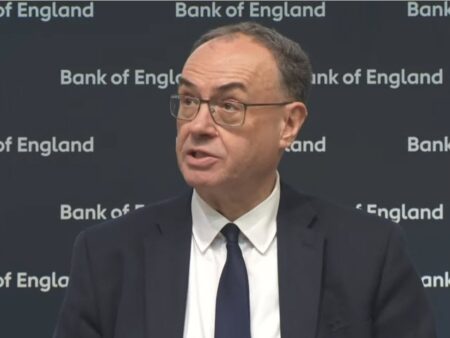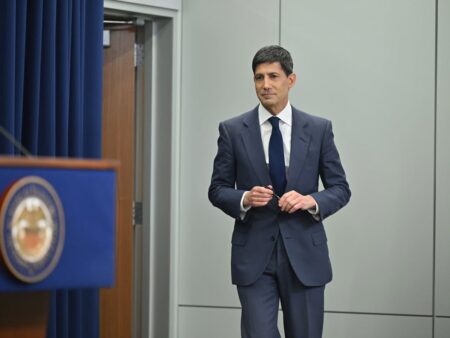
RBA Assistant Governor Sarah Hunter warns oil price pass-through into Australian consumer prices will be faster and more extensive given elevated capacity constraints and domestic cost pressures.
Summary:
Source: RBA Assistant Governor Sarah Hunter, prepared speech at the Bloomberg Forum for Investment Managers, Sydney, Tuesday 18 May 2026.
- Hunter described the Middle East conflict as a clear external shock hitting an economy already under capacity pressure with elevated domestic cost pressures
- The RBA raised rates for a third consecutive time this year to 4.35%, fully reversing the easing delivered in 2025
- Hunter said the recent rise in oil prices is particularly challenging to navigate, warning higher energy costs mean higher consumer prices in the near term
- RBA research suggests pass-through will be faster and more extensive than in previous episodes, with the risk of inflation expectations drifting higher described as elevated
- Some firms have already raised fuel surcharges; construction companies are reviewing prices on new contracts
- Hunter said RBA forecasts assume the Gulf conflict is resolved soon, but flagged that a longer or broader disruption would add to inflation
- Brent crude was trading above $110 a barrel at two-week highs on Monday, with the Strait of Hormuz still closed
- Hunter acknowledged a downside scenario in which households cut consumption and businesses scale back investment more than expected, which could result in lower inflation
The Reserve Bank of Australia has warned that oil price rises will feed through into domestic consumer prices faster and more extensively than in previous cycles, citing the stretched state of the economy as a key reason why the central bank cannot afford to treat the current energy shock as a temporary disturbance.
Sarah Hunter, RBA assistant governor for economics, delivered the remarks in a prepared speech at the Bloomberg Forum for Investment Managers in Sydney, confirming that concern about energy-driven inflation was a central factor behind the decision to raise the cash rate for a third consecutive time this year, lifting it to 4.35% and fully reversing the policy easing undertaken in 2025.
Hunter was direct about the difficulty the oil shock presents. Higher energy costs mean higher costs for businesses and higher consumer prices in the near term, she said, framing that outcome as a given rather than a risk to be managed. The complicating factor, she stressed, is that this shock has arrived against a backdrop of elevated capacity constraints and persistent domestic cost pressures, conditions that amplify rather than absorb the inflationary impulse from external price increases.
RBA research, she said, supports the view that the pass-through will be both faster and more extensive under current conditions than historical averages would suggest. That assessment carries significant weight for rate expectations, as it implies the Bank is not prepared to look through the energy shock on the assumption that its effects will be contained or self-correcting.
Evidence from the business sector reinforces the concern. Hunter noted that some firms have already moved to raise fuel surcharges, while construction companies are actively reviewing their pricing on new contracts. The construction sector signal is particularly notable given its exposure to both energy costs and broader materials inflation, and its importance to the non-tradeable component of the consumer price index.
Brent crude was trading above $110 a barrel at two-week highs on Monday, with the Strait of Hormuz remaining closed, maintaining the pressure on energy markets that prompted the RBA’s shift in assessment. Hunter said the Bank’s forecasts are built on the assumption that the Gulf conflict is resolved in the near term, but she was candid about the risks around that baseline. A prolonged closure, or a broadening of supply disruptions beyond current parameters, would add further to inflation and complicate the RBA’s task considerably.
Hunter also acknowledged the other side of the ledger. If households respond to higher energy prices by pulling back on consumption more sharply than expected, and if businesses scale back investment in response to uncertainty and higher costs, inflation could undershoot rather than overshoot. That scenario offers limited comfort, however, as it would imply a stagflationary outcome rather than a benign disinflation, leaving the RBA with little room to ease even if growth deteriorates.
—
Hunter’s explicit warning that pass-through will be faster and more extensive than in previous cycles is the most market-sensitive line in the speech, as it signals the RBA is not prepared to look through the oil shock as transitory. With the cash rate already back at 4.35%, fully reversing 2025’s easing, markets will now weigh whether a fourth consecutive hike is on the table if Brent holds above $110 and Hormuz remains closed. Construction sector price reviews are an early and concrete inflation signal that will keep the RBA’s attention focused on services and non-tradeable inflation alongside the direct energy channel. The downside scenario Hunter outlined, weaker consumption and business investment, offers little comfort given it implies stagflationary conditions rather than a clean disinflation.